
The term Spinosaurus Mirabilis links to one of the most unusual prehistoric predators ever studied. Ancient river systems, massive sail-like features, and crocodile-style jaws gave this dinosaur a shape far different from other meat-eating giants. Fossil discoveries across North Africa transformed scientific views about how giant dinosaurs survived millions of years ago.
Researchers connected Spinosaurus with semi-aquatic habits due to bone density, jaw structure, and tail design. Many paleontology fans compare it with other famous predators such as Tyrannosaurus rex, yet Spinosaurus showed traits linked more closely to water environments.
Origin of the Name Spinosaurus Mirabilis
The word “Spinosaurus” means “spine lizard.” Scientists selected this name after examining tall neural spines attached to the dinosaur’s vertebrae. These spines formed a huge sail across its back.
“Mirabilis” comes from Latin and points toward something extraordinary or astonishing. The phrase fits the dinosaur perfectly because fossil evidence revealed body features not seen in most large carnivores.
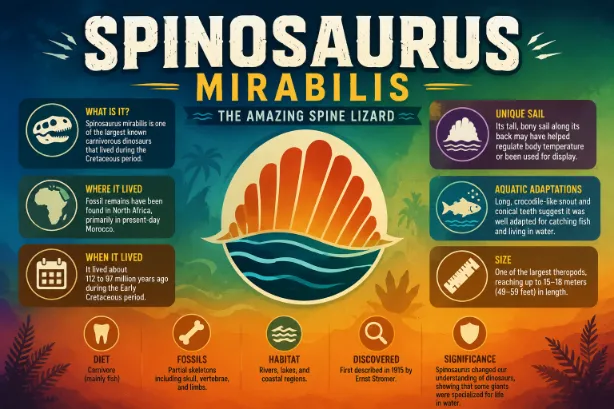
German paleontologist Ernst Stromer first described Spinosaurus fossils in 1915 after material surfaced in Egypt. Sadly, many original fossils vanished during World War II due to bombing in Munich.
Physical Appearance of Spinosaurus Mirabilis
Spinosaurus possessed a body structure very different from land-based predators. Scientists reconstructed its anatomy through fossils discovered in Morocco and nearby African regions.
Main Physical Traits
| Feature | Description |
|---|---|
| Length | Around 43 to 50 feet |
| Weight | Roughly 7 to 10 tons |
| Skull Shape | Long and narrow |
| Teeth | Conical and fish-catching |
| Sail Structure | Tall spinal sail on back |
| Habitat | River systems and wetlands |
The skull looked similar to a crocodile, with sensory openings that may have helped locate prey underwater. Sharp conical teeth suited slippery fish rather than bone crushing.
Features That Made Spinosaurus Different
- Long snout shaped for aquatic hunting
- Dense bones helping body control in water
- Large tail adapted for swimming movement
- Massive sail reaching several feet high
- Front limbs with strong claws
Recent fossil studies shifted old ideas about dinosaur lifestyles. Earlier reconstructions showed Spinosaurus as a standard land hunter, though modern analysis paints a more aquatic image.
Habitat and Environment
Spinosaurus lived during the Late Cretaceous Period around 95 million years ago. North Africa looked far different at that time. Rivers, lagoons, and swampy forests stretched across the region.
Scientists discovered fossils mainly in:
- Morocco
- Egypt
- Algeria
- Tunisia
Large fish thrived within these waterways. Such environments supplied perfect feeding grounds for a giant predator with aquatic adaptations.
Diet of Spinosaurus Mirabilis
Fish formed a major part of the Spinosaurus diet. Fossil evidence revealed teeth marks on fish bones and stomach-related fossil material connected with aquatic prey.
Likely prey animals:
- Giant prehistoric fish
- Sawfish relatives
- Small dinosaurs
- Aquatic reptiles
The dinosaur probably waited near riverbanks before lunging toward prey. Some paleontologists compare its hunting style with modern crocodiles.
The Sail on Its Back
The most striking body feature involved the enormous sail rising from its spine. Scientists proposed several theories about its purpose.
Possible functions:
- Body temperature regulation
- Display during mating rituals
- Species recognition
- Threat display toward rivals
No single explanation satisfies every researcher. Multiple purposes may have existed at the same time.
Spinosaurus vs Tyrannosaurus Rex
Many dinosaur fans compare Spinosaurus with Tyrannosaurus rex because both reached massive sizes.
| Trait | Spinosaurus | T. rex |
|---|---|---|
| Habitat | Wetlands and rivers | Forests and plains |
| Skull | Crocodile-like | Deep and powerful |
| Teeth | Thin and conical | Thick bone-crushing |
| Movement | Swimming ability | Strong land movement |
| Diet Focus | Fish-heavy diet | Large land animals |
T. rex possessed stronger bite force, while Spinosaurus showed superior aquatic adaptation.
Fossil Discoveries and Research
Moroccan fossil discoveries during the 21st century transformed scientific discussion surrounding Spinosaurus. Paleontologist Nizar Ibrahim helped reconstruct missing body parts using fresh fossil material.
These findings revealed:
- Shorter hind legs
- Paddle-like tail structure
- Improved swimming adaptation
- Forward body balance
The discoveries shifted public perception dramatically.
Scientific Debate Around Spinosaurus
Paleontology changes rapidly with each fossil discovery. Spinosaurus research generated debate for years because incomplete fossils caused uncertainty.
Researchers discussed topics such as:
- Swimming ability
- Body posture
- Tail movement
- Hunting behavior
- Sail function
Some scientists viewed Spinosaurus as fully aquatic, while others supported a shoreline predator lifestyle.
Pop Culture Presence
Spinosaurus reached global fame after appearing in movies, documentaries, toys, and video games. One of its biggest appearances came in Jurassic Park III.
Its unusual shape made it visually memorable among dinosaur fans.
Why Spinosaurus Fascinates Paleontologists
Several traits place Spinosaurus among the most discussed dinosaurs ever discovered.
Reasons behind scientific interest:
- Rare aquatic adaptation in giant theropods
- Unusual skeletal proportions
- Distinctive sail feature
- Constant fossil reinterpretation
- Fragmented fossil history
Fresh discoveries may still change modern reconstructions in future decades.
Misconceptions About Spinosaurus Mirabilis
Many internet sources spread inaccurate details regarding this dinosaur. Some reconstructions from older decades no longer match modern evidence.
| Myth | Reality |
|---|---|
| Spinosaurus looked like a giant T. rex with a sail | Body structure differed greatly |
| It lived fully underwater | Semi-aquatic behavior fits current evidence |
| Sail served one purpose only | Multiple theories remain active |
| Original fossils still exist | Many vanished during World War II |
Scientific interpretation evolves as fossil material grows.
Body Movement and Swimming Ability
Tail fossils discovered in Morocco suggested efficient water propulsion. The tail resembled shapes found in aquatic reptiles and fish.
Scientists performed digital simulations showing lateral tail movement could push the animal through water effectively.
Potential movement methods:
- Slow shoreline stalking
- River swimming
- Sudden ambush attacks
- Wading in shallow wetlands
These traits separated Spinosaurus from standard theropod predators.
Interesting Details About Spinosaurus Mirabilis
- Spinosaurus may rank among the longest carnivorous dinosaurs ever discovered.
- Fossils first surfaced over a century ago.
- Bone density resembled aquatic animals more than land hunters.
- Its nostrils sat farther back on the skull.
- The dinosaur thrived near giant river systems.
Scientific Reconstruction Through Technology
Modern paleontology uses advanced scanning and computer modeling to reconstruct extinct animals. Spinosaurus benefited heavily from such technology because original fossil material remained incomplete.
Researchers used:
- CT scans
- Digital skeleton assembly
- Tail motion simulations
- Bone density analysis
These methods improved accuracy compared with early 20th-century reconstructions.
Future Research Possibilities
North African fossil beds still hold major paleontological potential. Fresh discoveries may answer unresolved questions about Spinosaurus anatomy and behavior.
Researchers hope future fossils may reveal:
- Skin impressions
- More complete skull material
- Juvenile specimens
- Better limb structures
Each discovery adds another layer to the dinosaur’s scientific profile.
Spinosaurus Mirabilis remains one of the strangest predators from prehistoric Earth. Its crocodile-style skull, giant sail, and swimming adaptations separated it from traditional dinosaur imagery. Fossil discoveries from Africa reshaped scientific thought regarding giant carnivorous dinosaurs and aquatic lifestyles.
Modern research keeps refining the picture of this extraordinary reptile. New fossils and digital technology may reshape current interpretations again in coming years, making Spinosaurus one of paleontology’s most actively discussed prehistoric animals.