
El Dado translates to “the die” or “the dice” in Spanish. Across Spanish-speaking regions, this simple object has served as a tool for games, decision-making, entertainment, and mathematical learning for centuries. Small in size yet rich in cultural value, El Dado appears in family gatherings, board games, classrooms, casinos, and recreational activities.
From ancient civilizations to modern digital gaming, dice remain part of everyday life. Their straightforward design and random outcomes create excitement and fairness in many activities.
Meaning of El Dado
The Spanish word “dado” refers to a cube-shaped object marked with numbered faces. In most situations, the numbers range from one to six. A person rolls the die to generate a random result.
The term may refer to:
- A single die
- A gaming tool
- A mathematical teaching aid
- A symbol of chance
- A component of tabletop games
In Spanish grammar:
| Term | Meaning |
|---|---|
| El Dado | The die |
| Los Dados | The dice |
| Tirar el dado | Roll the die |
| Juego de dados | Dice game |
Historical Background of El Dado
Dice rank among the oldest gaming objects in human civilization. Archaeological discoveries reveal that people used dice thousands of years ago in different regions of the world.
Ancient societies crafted dice from:
- Bone
- Stone
- Wood
- Ivory
- Clay
Historians have found early dice in areas connected to:
- Ancient Egypt
- Mesopotamia
- Greece
- Rome
- China
Spanish culture later adopted dice through centuries of trade, social interaction, and recreational gaming. The word “dado” gradually became part of everyday language across Spain and Latin America.
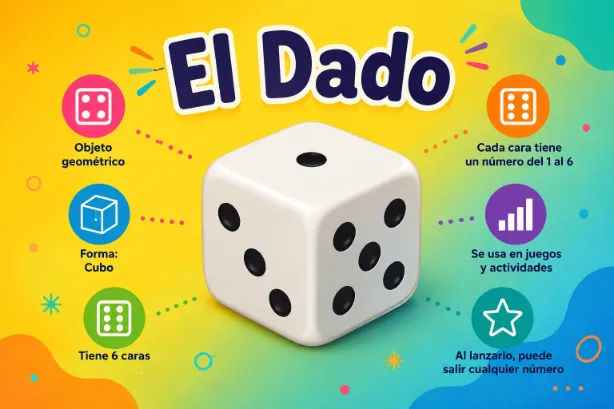
Physical Characteristics
A traditional die contains six square faces.
| Face | Dot Count |
|---|---|
| One | ● |
| Two | ●● |
| Three | ●●● |
| Four | ●●●● |
| Five | ●●●●● |
| Six | ●●●●●● |
Manufacturers design dice with balanced weight distribution to promote fair results.
Common materials used today:
- Plastic
- Resin
- Metal
- Acrylic
- Wood
Special editions may feature decorative engravings, unique colors, or themed designs.
El Dado in Traditional Games
Dice play a central role in many popular games. A simple roll can determine movement, scoring, rewards, penalties, or victory.
Popular examples:
- Ludo
- Backgammon
- Yahtzee
- Monopoly
- Parcheesi
- Various card-and-dice combinations
Players enjoy dice-based games because every roll introduces unpredictability. Skill may affect strategy, yet random outcomes create excitement for everyone involved.
El Dado in Spanish-Speaking Countries
Many Spanish-speaking families grow up using dice in social gatherings and celebrations.
Common activities involving El Dado:
- Family game nights
- School competitions
- Community gatherings
- Holiday entertainment
- Recreational tournaments
Dice games remain popular because they require minimal equipment and are easy to learn.
Educational Value of El Dado
Teachers frequently use dice as classroom tools.
Students learn concepts such as:
- Counting
- Addition
- Subtraction
- Multiplication
- Probability
- Statistics
A simple classroom activity may involve rolling a die multiple times and recording results. Students then analyze patterns and frequencies.
Educational benefits:
- Encourages participation
- Makes learning interactive
- Develops analytical skills
- Strengthens number recognition
- Improves logical reasoning
Probability and El Dado
Dice provide one of the simplest demonstrations of probability.
For a standard six-sided die:
| Outcome | Probability |
|---|---|
| 1 | 1/6 |
| 2 | 1/6 |
| 3 | 1/6 |
| 4 | 1/6 |
| 5 | 1/6 |
| 6 | 1/6 |
Each face has an equal chance of appearing during a fair roll.
Probability lessons using dice help students understand:
- Randomness
- Statistical analysis
- Predictive reasoning
- Experimental mathematics
El Dado in Casinos
Many casino games rely on dice.
Popular examples:
- Craps
- Sic Bo
- Various regional dice games
Casino-grade dice undergo strict manufacturing standards. Precise dimensions and balanced construction help maintain fairness.
Features of casino dice:
- Transparent material
- Sharp edges
- Precise numbering
- Quality testing procedures
Gaming establishments monitor dice carefully to prevent manipulation.
Symbolism of El Dado
Throughout history, dice have represented chance and uncertainty.
Common symbolic meanings:
- Luck
- Risk
- Opportunity
- Fortune
- Decision-making
Writers, artists, and filmmakers frequently use dice imagery to represent moments where outcomes remain unknown.
The phrase “rolling the dice” appears in many languages as a metaphor for taking a chance.
Types of Dice
Although the six-sided version remains the most familiar, many other forms exist.
| Type | Sides |
|---|---|
| Standard Die | 6 |
| Octahedral Die | 8 |
| Pentagonal Trapezohedron | 10 |
| Dodecahedral Die | 12 |
| Icosahedral Die | 20 |
Role-playing games frequently use these specialized dice.
Players may encounter:
- D4
- D6
- D8
- D10
- D12
- D20
Each shape serves specific gaming mechanics.
El Dado in Modern Technology
Digital entertainment has transformed the traditional dice experience.
Modern applications feature:
- Virtual dice rollers
- Mobile gaming platforms
- Educational software
- Online board games
- Probability simulators
Digital versions replicate random outcomes through algorithms designed to mimic physical rolls.
Many players still prefer physical dice because of the tactile experience and visual excitement.
Collectible Dice
A growing community enjoys collecting unique dice.
Popular collectible categories:
- Handmade resin dice
- Metal dice
- Gemstone dice
- Vintage dice
- Limited-edition gaming sets
Collectors appreciate craftsmanship, rarity, and artistic design.
Some specialty sets display:
- Metallic finishes
- Embedded artwork
- Glow effects
- Custom numbering
- Luxury materials
Dice Etiquette During Games
Good gaming habits contribute to a positive experience.
Recommended practices:
- Roll within designated areas
- Respect game rules
- Avoid altering results
- Handle dice carefully
- Verify outcomes honestly
Fair play creates trust among participants and improves overall enjoyment.
Fun Facts About El Dado
- The opposite sides of a traditional die total seven.
- Ancient dice existed thousands of years ago.
- Dice appear in hundreds of game variations worldwide.
- Mathematical probability studies frequently use dice examples.
- Specialized dice can contain more than twenty sides.
- Some luxury dice are crafted from precious materials.
Why El Dado Remains Popular
Several qualities support the lasting popularity of dice:
- Easy to use
- Affordable
- Portable
- Suitable for all ages
- Useful for education
- Compatible with countless games
A single die can create hundreds of possible gaming experiences. This versatility helps maintain its place in households, schools, gaming clubs, and entertainment venues across the globe.
El Dado represents far more than a small numbered cube. It serves as a gaming accessory, educational resource, mathematical demonstration tool, and cultural symbol. Ancient civilizations relied on dice for recreation, and modern communities still enjoy them for many of the same reasons. Their simplicity, fairness, and universal appeal make El Dado a timeless part of human entertainment and learning.