
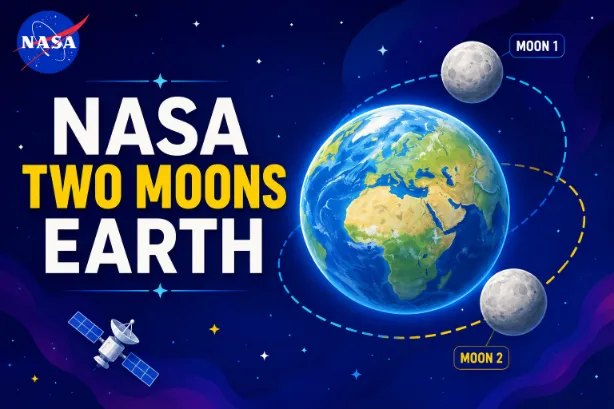
Earth already has one natural satellite: the Moon. Yet astronomers connected with NASA have confirmed that small asteroids sometimes enter Earth’s gravitational field for a short period. During that phase, people casually call them “two moons.” These objects stay for weeks, months, or sometimes less before drifting back into space.
The phrase “Nasa Two Moons Earth” started trending after reports about temporary mini-moons spread across science websites and social platforms. Many readers imagined a second giant moon beside the familiar lunar body. Real science paints a very different picture. These temporary visitors remain tiny, faint, and nearly impossible to spot without advanced telescopes.
How Earth Gets a Temporary Second Moon
Space around Earth stays busy with asteroids and rocky fragments. Some pass close enough for Earth’s gravity to pull them into orbit for a short time. Astronomers call these objects “temporarily captured orbiters.”
Instead of circling Earth forever, these mini-moons follow unstable paths. The gravity of the Sun and Earth works together, pushing and pulling the object until it eventually escapes.
A temporary mini-moon usually has these traits:
- Small size compared to Earth’s Moon
- Dim appearance in the night sky
- Short orbital period around Earth
- Unstable trajectory
- Difficult detection through normal telescopes
Scientists monitor these objects carefully because they help researchers learn more about asteroid motion and planetary gravity.
The Mini-Moon Linked With NASA Reports
One of the best-known temporary moons appeared in 2020. Astronomers identified asteroid 2020 CD3 orbiting Earth briefly before moving away again. Researchers connected with NASA and other observatories studied it closely.
The object measured only a few meters across. Human eyes could never see it without powerful equipment. Still, the discovery created excitement because it proved Earth can temporarily host another natural satellite.
Earth’s Main Moon vs Temporary Mini-Moon
| Feature | Earth’s Moon | Temporary Mini-Moon |
|---|---|---|
| Size | 3,474 km diameter | Few meters wide |
| Orbit Stability | Stable | Unstable |
| Visibility | Easily visible | Requires telescopes |
| Duration Around Earth | Permanent | Weeks or months |
| Formation | Ancient natural satellite | Captured asteroid |
| Scientific Interest | High | Extremely high |
Why NASA Watches These Objects
Astronomers study mini-moons for several reasons. These rocky visitors create opportunities for scientific research without traveling deep into the solar system.
Researchers examine:
- Orbital movement
- Surface composition
- Rotation speed
- Gravity interaction
- Potential future asteroid missions
Mini-moons also help engineers prepare future space missions. A small asteroid orbiting close to Earth gives scientists a practical target for robotic exploration.
Could Earth Ever Have Two Permanent Moons?
Science fiction movies love this idea, but real astronomy says the chance remains extremely low. Earth’s gravity and the gravitational pull of the Sun make stable dual-moon systems difficult.
A permanent second moon would require:
- Proper orbital distance
- Stable velocity
- Balanced gravitational interaction
- Massive size stability
Without those conditions, a captured object would either crash into Earth, drift away, or collide with the existing Moon after enough time.
Ancient Beliefs About Multiple Moons
Ancient civilizations watched the sky carefully. Strange lights, comets, eclipses, and atmospheric effects sometimes led people to believe Earth had extra moons.
Several historical records mention unusual nighttime objects:
- Bright comets mistaken for moons
- Optical illusions caused by ice crystals
- Planet sightings near the Moon
- Temporary celestial bodies
Modern telescopes now separate myth from measurable astronomy.
How Scientists Detect Temporary Moons
Mini-moons move quickly and remain faint. Astronomers rely on advanced observatories and digital imaging systems.
Detection methods involve:
- Wide-field sky surveys
- Motion-tracking software
- Repeated telescope imaging
- Orbit calculations
- Infrared observations
Programs connected with NASA search for near-Earth objects daily. Many discoveries happen through automated systems that scan huge areas of the sky every night.
Could a Mini-Moon Hit Earth?
Most temporary moons pose no danger. Their small size means many would burn up in Earth’s atmosphere before reaching the ground.
Still, scientists monitor near-Earth objects carefully. Space agencies track asteroid paths to detect any possible collision risk early.
Important monitoring goals:
- Predict orbital paths
- Track speed changes
- Measure object size
- Study atmospheric entry patterns
- Improve planetary defense systems
Planetary defense programs remain active across several countries because asteroid detection protects Earth from future threats.
Public Fascination With Two Moons
The phrase “Earth has two moons” spreads rapidly online because it sounds dramatic. Social media users share edited sky photos and exaggerated headlines that create confusion.
Real temporary moons appear tiny and faint. Most people would never notice one in the sky.
Popular reasons behind public fascination:
- Space mysteries attract attention
- Rare celestial phenomena excite readers
- Moon-related myths stay popular
- Viral astronomy headlines spread quickly
Astronomy enthusiasts still appreciate these discoveries because they reveal how active and unpredictable space can be.
NASA’s Role in Near-Earth Object Tracking
NASA runs several observation programs focused on near-Earth objects. These projects scan the sky for asteroids, comets, and temporary captured bodies.
Major goals involve:
- Detecting potentially hazardous asteroids
- Mapping orbital movement
- Studying asteroid composition
- Supporting future missions
- Improving planetary safety systems
Scientists around the world share observation data through international collaborations.
Famous Temporary Moons Recorded By Astronomers
A few mini-moons entered scientific records over recent decades. Each discovery improved scientific models related to gravitational capture.
Examples of documented temporary moons:
| Object Name | Discovery Year | Approximate Size | Notes |
|---|---|---|---|
| 2006 RH120 | 2006 | 2–3 meters | Orbited Earth for about a year |
| 2020 CD3 | 2020 | 1–2 meters | Confirmed temporary mini-moon |
| 2022 NX1 | 2022 | Small asteroid | Passed through Earth’s gravitational region |
These objects remain tiny compared to Earth’s Moon, yet researchers value them highly for orbital analysis.
Can People See a Second Moon Without Telescopes?
In nearly all cases, no. Temporary mini-moons stay too faint for naked-eye viewing. Professional telescopes and long-exposure imaging help astronomers locate them.
Visibility depends on:
- Object brightness
- Distance from Earth
- Atmospheric conditions
- Telescope strength
- Orbital position
Large observatories produce the clearest images because these asteroids reflect very little sunlight.
Future Space Missions and Mini-Moons
Scientists see temporary moons as possible mission targets. Their proximity to Earth reduces travel distance and mission costs.
Potential mission goals:
- Collect asteroid samples
- Test robotic landing systems
- Study asteroid minerals
- Practice deep-space navigation
- Prepare future mining technology
Several researchers believe mini-moons may support future space exploration programs.
Why This Topic Became Viral Online
Search trends exploded after headlines claimed Earth would temporarily gain another moon. Many readers pictured a huge glowing object beside the familiar lunar body.
Most reports simplified the science for easy reading. In reality, temporary mini-moons remain small asteroid fragments captured briefly by Earth’s gravity.
Internet popularity grew because:
- The phrase sounds dramatic
- Space topics attract massive audiences
- Social media spreads simplified headlines rapidly
- Moon imagery creates excitement
Astronomy communities later clarified the scientific details behind the reports.
Scientific Value of Temporary Moons
Temporary moons help researchers improve space science in several areas:
- Gravity modeling
- Orbital mechanics
- Asteroid composition research
- Collision prediction systems
- Space mission planning
These discoveries also remind humanity that Earth exists within an active cosmic environment filled with moving objects.
The phrase “Nasa Two Moons Earth” sounds dramatic, yet the science behind it stays even more fascinating. Earth sometimes captures tiny asteroids that orbit briefly before returning to space. These mini-moons stay small, dim, and temporary, though they provide valuable research opportunities for astronomers.
Modern observation systems operated by NASA and global observatories keep scanning the skies for new discoveries. Each temporary moon adds another layer to humanity’s growing knowledge of the solar system and the complex gravitational dance happening above Earth every day.