
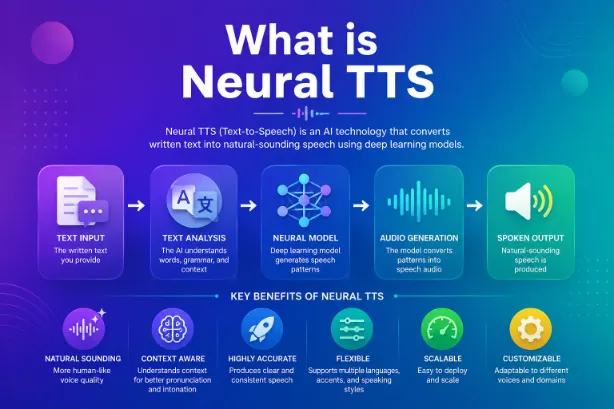
Neural TTS stands for Neural Text-to-Speech. This technology changes written text into human-like speech through artificial intelligence models. Older speech systems sounded robotic and flat. Neural TTS creates smoother pronunciation, better rhythm, and natural emotion.
Voice assistants, audiobook apps, customer service bots, language learning platforms, and video creators now use Neural TTS for realistic speech generation. Many companies rely on this method to improve user experience and reduce manual voice recording work.
Modern systems process large datasets of human speech. The AI studies pronunciation, pauses, tone, and speaking style. After training, the system generates speech that sounds close to real human conversation.
How Neural TTS Works
Neural TTS uses deep learning networks to convert text into audio. The process happens in several stages.
| Stage | Description |
|---|---|
| Text Analysis | The system reads and organizes written content |
| Linguistic Processing | AI checks pronunciation, punctuation, and sentence structure |
| Acoustic Modeling | Neural networks create speech patterns |
| Vocoder Processing | The system transforms patterns into audio waves |
| Final Output | Users hear natural-sounding speech |
Traditional TTS systems depended on pre-recorded sound fragments. Neural TTS creates speech through AI-generated voice modeling instead of stitched audio clips.
Main Components of Neural TTS
Several technologies work together inside a Neural TTS system.
Deep Neural Networks
These networks train on thousands of voice recordings. They learn speaking styles, emotions, and pronunciation rules.
Natural Language Processing
NLP helps the software read text properly. It handles punctuation, abbreviations, numbers, and sentence flow.
Vocoders
A vocoder converts AI speech patterns into real sound waves. Modern vocoders create cleaner and smoother voices.
Speech Synthesis Models
These models shape the final voice output. Popular architectures produce speech with natural pacing and tone variation.
Neural TTS vs Traditional TTS
The difference between modern and older speech systems appears immediately after listening.
| Feature | Traditional TTS | Neural TTS |
|---|---|---|
| Voice Quality | Robotic | Human-like |
| Tone Variation | Limited | Natural |
| Pronunciation | Sometimes awkward | More accurate |
| Emotional Expression | Weak | Strong |
| Speech Smoothness | Choppy | Fluid |
| User Experience | Mechanical | Conversational |
Many users prefer Neural TTS because it sounds less artificial.
Benefits of Neural TTS
Neural TTS delivers many advantages for businesses, creators, and app developers.
Natural Voice Output
Speech sounds realistic with proper pacing and intonation. Listeners stay engaged longer.
Faster Content Production
Content creators generate narration without hiring voice actors for every project.
Multi-Language Support
Many systems support dozens of languages and regional accents.
Better Accessibility
People with visual impairments can listen to written material more comfortably.
Scalable Audio Creation
Companies create thousands of voice responses instantly through automation.
Common Uses of Neural TTS
Neural speech technology now appears across many industries.
Virtual Assistants
Smart assistants use Neural TTS for more conversational interactions.
Audiobooks
Publishers generate audiobook narration faster than manual recording sessions.
E-Learning Platforms
Educational apps convert lessons into spoken content for students.
Customer Service Systems
Automated phone systems use AI-generated voices for support calls.
Video Narration
YouTubers and marketers create voiceovers quickly through text prompts.
GPS Navigation
Navigation apps provide clearer spoken directions with smoother pronunciation.
Popular Neural TTS Platforms
Several companies provide advanced Neural TTS services.
| Platform | Specialty |
|---|---|
| AI voice generation and cloud speech services | |
| Amazon | Scalable cloud-based speech synthesis |
| Microsoft | Enterprise-grade neural voices |
| IBM | AI communication tools |
| OpenAI | Advanced conversational voice systems |
These providers support developers through APIs and cloud integration tools.
Why Neural TTS Sounds More Human
Human speech contains rhythm, pitch variation, pauses, and emotional tone. Traditional systems struggled with these patterns. Neural TTS studies huge amounts of real speech data and reproduces those characteristics more accurately.
AI models also process context inside sentences. A question sentence receives a different tone than a statement. Excitement, sadness, and emphasis sound more natural through neural voice generation.
Neural TTS and Artificial Intelligence
Artificial intelligence powers every layer of Neural TTS. Machine learning models train on voice recordings from real speakers. The AI studies:
- Pronunciation patterns
- Word stress
- Speaking speed
- Accent variation
- Emotional tone
- Pause placement
After training, the system predicts speech patterns from new text input.
Languages and Accent Support
Modern Neural TTS systems support global communication through multiple accents and languages.
Popular language support areas:
- English
- Spanish
- Arabic
- French
- German
- Chinese
- Hindi
- Urdu
- Japanese
Some platforms also provide regional accents such as American English, British English, and Australian English.
Neural TTS for Content Creators
Video creators, podcasters, bloggers, and educators use AI narration tools daily.
Benefits for creators:
- Faster production workflow
- Lower recording costs
- Multiple voice styles
- Easy script editing
- Consistent audio quality
Creators also generate multilingual narration for global audiences.
Challenges in Neural TTS
Despite major improvements, some limitations still exist.
Emotional Accuracy
Certain emotions sound less authentic compared to real human voices.
Pronunciation Errors
Complex names or uncommon words may sound incorrect.
Ethical Concerns
Some people misuse AI-generated voices for fake recordings or impersonation.
Processing Costs
High-quality speech generation needs strong computing resources.
Neural TTS and Accessibility
Accessibility remains one of the strongest uses of this technology.
People with reading difficulties or visual impairments benefit from realistic voice playback. Educational platforms also support students through spoken lessons and interactive reading tools.
Public websites now add AI narration to improve accessibility standards.
Future of Neural TTS
Speech synthesis technology improves rapidly every year. Developers now focus on:
- Real-time voice generation
- Emotion-rich speech
- Personalized AI voices
- Faster response speed
- Better multilingual support
Future systems may sound nearly identical to real human speakers.
Security and Ethical Questions
AI-generated speech creates both opportunities and risks. Developers now create safeguards against voice cloning misuse and fake audio scams.
Many companies use voice authentication systems and watermarking methods to reduce fraud risks.
Responsible AI development remains a major topic across the tech industry.
Neural TTS in Mobile Applications
Mobile apps rely heavily on speech technology. Language learning apps, meditation apps, navigation tools, and digital assistants all use neural voice generation.
Smartphone users now expect natural audio interaction instead of robotic voices.
Neural TTS for Businesses
Businesses use Neural TTS to improve communication and automation.
Common Business Applications
- Interactive voice response systems
- AI customer support
- Training materials
- Product tutorials
- Voice-enabled apps
- Marketing campaigns
Companies reduce production time while maintaining professional audio quality.
Neural TTS and Voice Cloning
Some advanced systems create custom AI voices from short voice samples. This process is called voice cloning.
Voice cloning helps:
- Film dubbing
- Personalized assistants
- Audiobook narration
- Accessibility support
Strict ethical rules remain necessary to prevent misuse.
Neural TTS has transformed speech synthesis through artificial intelligence and deep learning. Modern systems generate smoother, clearer, and more natural voices than older text-to-speech technology.
Businesses, educators, creators, and app developers now rely on AI-generated speech for faster communication and better user interaction. As machine learning improves, speech quality will move even closer to real human conversation.
People already hear Neural TTS daily through assistants, navigation apps, customer service systems, and digital content platforms. The technology now shapes how humans interact with software across the digital world.